


Tarp Sizes Guide: Standard Sizes & How to Measure for a Custom Tarp
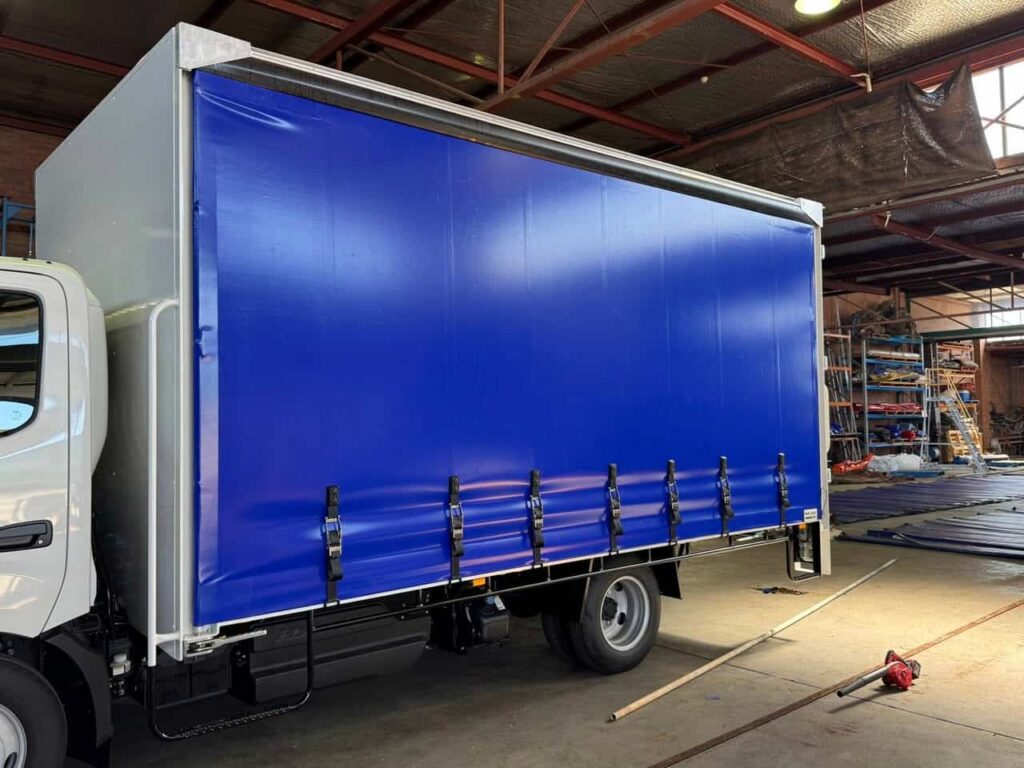
Choosing the right tarp size sounds simple until the tarp arrives. Too small and your load is exposed to the elements, from heavy rain to dust and UV. Too big and the excess fabric flaps in the wind, wears faster and becomes hard to secure.
Standard tarp sizes work well for general covering jobs, but trucks, trailers, machinery and large stockpiles often need something made to measure. In this blog, Bee Jays Canvas explains the most common tarpaulin sizes in Australia, the difference between cut size and finished size, and how to measure for a custom tarp that fits properly the first time.
What Are The Standard Tarp Sizes In Australia?
Standard tarp sizes in Australia range from 1.8 m x 2.4 m for small box trailers, up to 9.0 m x 12.0 m for large hay stacks and construction sites. Many of these sizes are converted from feet, so you may also see a 3.0 m x 3.6 m tarp sold as 10 ft x 12 ft.
Standard tarps are popular for their versatility, as one size can suit several jobs. The table below shows common standard tarpaulin sizes and what they are typically used for.
| Tarp Size (Metric) | Approximate Imperial Size | Common Uses |
|---|---|---|
| 1.8 m x 2.4 m | 6 ft x 8 ft | Small box trailers, firewood, tools and small equipment |
| 2.4 m x 3.0 m | 8 ft x 10 ft | Larger box trailers, ute trays and outdoor furniture |
| 3.0 m x 3.6 m | 10 ft x 12 ft | Tandem trailers, small machinery and building materials |
| 3.6 m x 5.4 m | 12 ft x 18 ft | Small boats, pallets of stock and temporary ground covers |
| 4.8 m x 6.0 m | 16 ft x 20 ft | Vehicles, larger machinery and storm-damaged roof sections |
| 6.0 m x 9.0 m | 20 ft x 30 ft | Hay stacks, stockpiles and site coverings |
| 9.0 m x 12.0 m | 30 ft x 40 ft | Large hay and grain stacks, construction sites and industrial storage |
These tarp sizes are a useful starting point, but most off the shelf options are medium-duty tarps built for general use. For transport, mining, agriculture or oil and gas applications, heavy-duty tarps made to size give the fit, strength and tie-down points the job needs.
Reinforced edges and strong fixing points are especially useful for larger tarps. Brass eyelets on heavy-duty tarps are typically spaced around 1 m apart or closer, and on a custom tarp they can be placed to line up with your tie-down points.
What Size Tarp Do I Need For A Trailer, Ute Or Container?
Use the table below as a quick guide. Recommended sizes assume a flat load with about 300 mm of drop on each side.
| Application | Typical Dimensions | Recommended Tarp Sizes |
|---|---|---|
| 6 x 4 box trailer | 1.8 m x 1.2 m | 2.4 m x 1.8 m |
| 7 x 5 box trailer | 2.1 m x 1.5 m | 3.0 m x 2.4 m |
| 8 x 5 box trailer | 2.4 m x 1.5 m | 3.0 m x 2.4 m |
| Single cab ute tray | Approx. 2.4 m x 1.8 m | 3.0 m x 2.4 m |
| 20 ft open-top container | Approx. 6.06 m x 2.44 m | Custom, approx. 6.7 m x 3.0 m |
| 40 ft open-top container | Approx. 12.19 m x 2.44 m | Custom, approx. 12.8 m x 3.0 m |
| Semi-trailer or flat-top deck | Varies by trailer | Custom, measured to the load and tie-down points |
Tray and trailer sizes vary between manufacturers, so always measure your own before ordering. If your load sits above the sides, use the height formula in the overhang section below.
Cut Size Vs Finished Size: What Is The Difference?
Cut size is the size of the fabric before the edges are hemmed, while finished size is the true size of the completed tarp. Knowing which one a supplier quotes can be the difference between a tarp that fits and one that falls short.
- Cut size: The size of the fabric before it is hemmed, seamed or fitted with eyelets.
- Finished size: The actual size of the tarp once the edges are folded, stitched or welded and the hardware is added.
Many budget poly tarps are labelled by cut size, so the finished tarp can be noticeably smaller than the label suggests, especially on larger sizes. If a tight fit matters, always confirm the finished dimensions before you buy. When you order a custom tarp, give your required finished size so the manufacturer can allow for hems and reinforcement.
How To Measure For A Custom Tarp
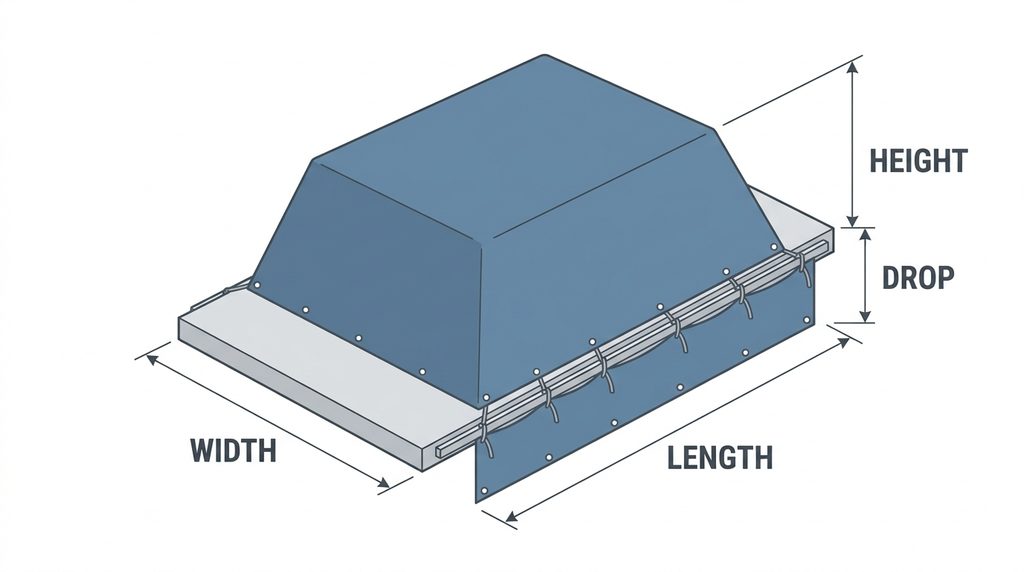
To measure for a custom tarp, record the length, width and height of what you are covering and add enough drop to secure it. Use a steel tape and work in millimetres. It also helps to know what the tarp needs to do before you start.
- Length: Measure front to back at the longest point. Include anything that sticks out.
- Width: Measure side to side at the widest point, usually the outside edge of the deck.
- Height: For 3D loads, measure from the deck to the highest point.
- Drop: Add enough to reach your tie-down points.
- Fixings: Mark where your rails and tie-down points sit. Note anything that needs a cut-out, like an exhaust or ladder.
- Check: Sketch it with your measurements, take a few photos and measure again.
How Much Overhang Does A Tarp Need?
The drop is how far the tarp extends past the edge of the deck, tray or load. It gives you enough fabric to reach tie-down points, stops water pooling at the edges and helps protect the load by keeping wind from getting underneath.
As a general guide, allow 150 mm to 300 mm of drop on each side for a flat deck or trailer, and more where tie-down points sit low.
| Application | Recommended Drop (Each Side) | Why |
|---|---|---|
| Flat deck or tray with rails at deck level | 150 mm to 300 mm | Reaches the rails without loose excess fabric |
| Trailer with low rails or tie points below the deck | 300 mm or more | Extra fabric to reach lower fixing points |
| Open-top container | 150 mm to 300 mm | Wraps the top rail to secure to lashing points |
| Load with height (machinery, pallets) | Full load height plus 150 mm to 300 mm | Covers the sides before reaching the tie points |
| Hay stacks and stockpiles | Full stack height plus extra at the base | Allows the edges to be weighed down or tied off |
For a flat load, add the drop to both ends and both sides. For example, a 2.4 m x 1.8 m trailer with 200 mm of drop needs a tarp of about 2.8 m x 2.2 m.
For a load with height, the tarp also needs to cover the sides of the load. Add twice the height to the length and width, then add the drop. For example, a load that is 3.0 m long, 2.0 m wide and 1.0 m high, with 300 mm of drop, needs a tarp of about 5.6 m x 4.6 m.
In harsh WA weather conditions, a tarp that is pulled tight with the right amount of drop will last longer than one that is loose and flapping. Wind movement and prolonged exposure to sunlight are two of the biggest causes of wear, which is covered in our guide on how long a tarp will last outside.
Measuring For Truck Tarps, Side Curtains And Container Tarps
Transport tarps are where standard tarp sizes fall short. Every truck body, trailer and frame is slightly different, and a poor fit can affect load protection, curtain tension and safety on the road.
Here is what to measure for each type of transport tarp:
| Tarp Type | What To Measure |
|---|---|
| Truck side curtains | Length between the front and rear posts, height from the top rail to the bottom rave rail, and the position of buckles, straps and load restraint equipment |
| Roll tarps and pull-out tarps | Deck length and width, the height and spacing of bows or gates, and the type of roll mechanism fitted |
| Container tarps | Internal and external dimensions of the open-top container and the position of lashing points |
| Hay and stack covers | Stack length, width and height, plus extra fabric to weigh or tie down at the base |
Any tarp fitted to a heavy vehicle should also keep the vehicle within legal dimension limits. Under the Heavy Vehicle National Law, the general limits are 2.5 m wide and 4.3 m high, including the load (NHVR mass and dimension limits). WA applies the same general limits under the Road Traffic (Vehicles) Regulations 2014, administered by Main Roads WA.
For side curtains, roll tarps and container tarps, we recommend having the manufacturer take or check the measurements. Bee Jays Canvas uses AutoCAD to design tarps for a precise fit, which reduces the risk of costly remakes and downtime.
What Information Do You Need For A Custom Tarp Quote?
The more detail you provide, the faster and more accurate your quote will be. Before contacting a manufacturer, have the following ready:
- Finished dimensions: Length, width and height in millimetres, including drop.
- What the tarp is for: Transport, storage, site protection, containment or something else.
- Material preference: PVC, canvas or polyethylene, or ask for advice on durability and UV protection.
- Fixings: Metal eyelets, D-rings, rope hems, buckles, straps or ratchets, and their spacing, so you can fasten the tarp securely.
- Extras: Reinforced corners and wear strips for extra strength, plus flaps, cut-outs, colours or logo printing.
- Photos and sketches: A labelled diagram and photos of the vehicle, load or structure.
Material choice matters as much as size. A heavy-duty PVC tarp, such as German-made Mehler 900gsm, is highly durable, waterproof and offers strong UV resistance, making it ideal for transport and long-term outdoor use in WA’s heat. Canvas is breathable and versatile, suiting loads that need airflow, while polyethylene is a lighter option for shorter-term covering. Our guide to types of tarp fabrics explains the differences in more detail.
Need a tarp for a short job instead? Bee Jays also offers tarp hire in Perth in a range of standard sizes.
Need A Custom Tarp Made To Size?
When a standard tarp size won’t do the job, Bee Jays Canvas can help. Our Welshpool team has manufactured durable custom tarps and truck curtains for nearly 40 years, and every tarp is backed by a 5-year workmanship warranty.
Contact us or call (08) 9451 8484 to discuss your measurements and get a quote.
Frequently Asked Questions
Measure the length, width and height of what you are covering, then add 150 mm to 300 mm of drop on each side so the tarp can be secured. For loads with height, add twice the height to both the length and width as well.
Smaller sizes such as 1.8 m x 2.4 m and 2.4 m x 3.0 m are among the most common, as they suit box trailers, ute trays and general covering. Transport and industrial tarps are usually made to measure.
Yes. Bee Jays Canvas specialises in custom and large-scale tarps, including oversized and out-of-the-ordinary projects that standard suppliers cannot handle. Contact the team with your measurements to discuss your requirements.
In many cases, yes. Bee Jays offers tarp repairs at its Welshpool facility and a mobile repair service across Perth and regional WA. If the tarp no longer fits properly or the fabric is badly worn, a new custom tarp may be the better option.
What our customers say
